Key takeaways
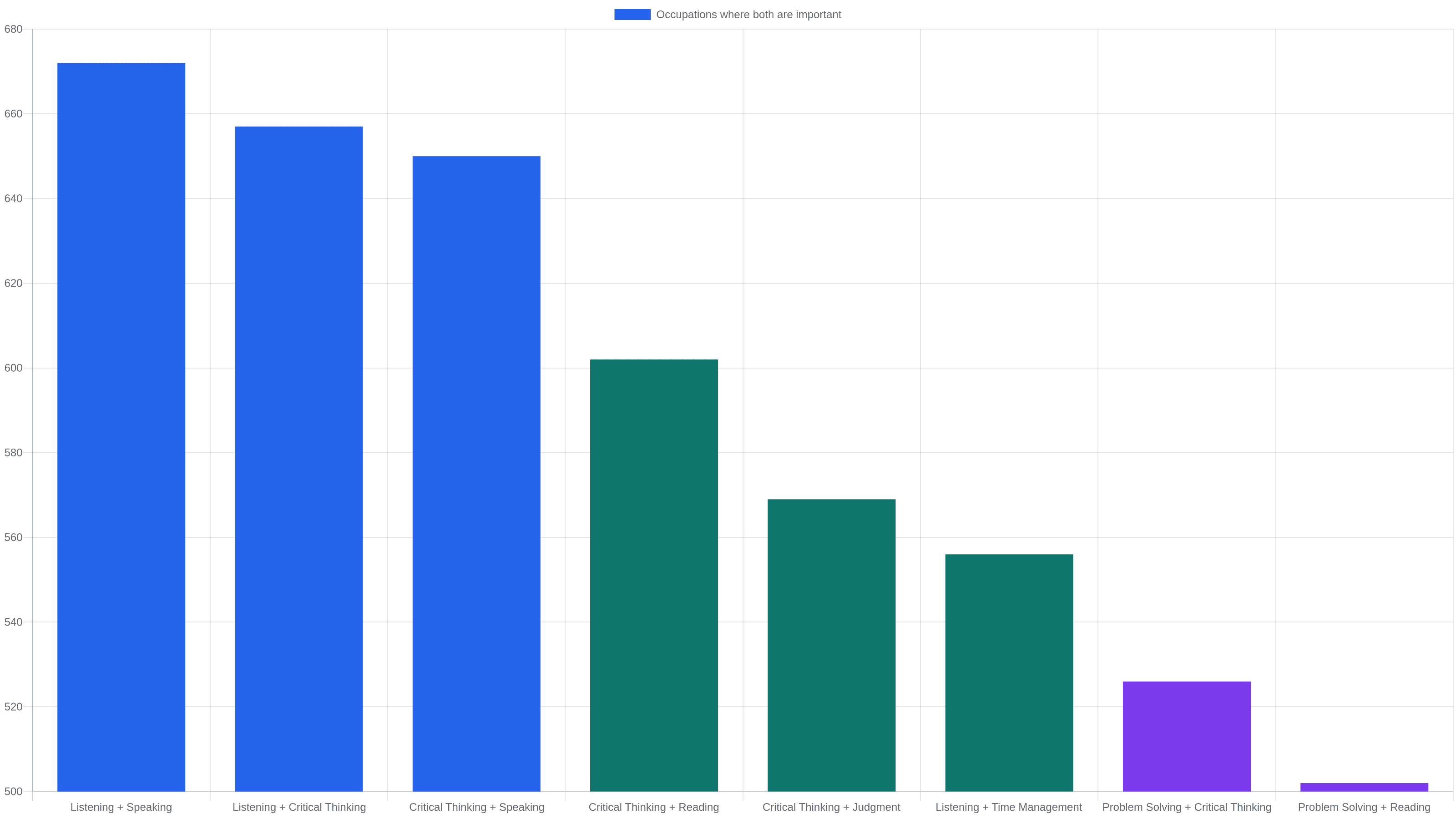
Active Listening + Speaking overlaps in 672 occupations. Active Listening + Critical Thinking reaches 657. Complex Problem Solving + Reading Comprehension reaches 502 with a $76,590 median associated wage. Pair counts overlap and do not establish causality, proficiency, or current demand.
Workers are rarely hired for one skill in isolation. A strong listener who cannot explain a recommendation may struggle. A critical thinker who cannot understand written evidence has a constraint. A problem solver who lacks judgment can produce activity without a useful decision.
That is why skill pairs are a more realistic way to think about career optionality. SmartBid’s analysis of O*NET 31.0 and BLS occupation data found that active listening and speaking are both rated important in 672 occupations. Active listening and critical thinking overlap in 657. Critical thinking and speaking overlap in 650. More differentiated pairs—such as complex problem solving plus critical thinking—still span more than 500 occupations while shifting toward a higher median occupational wage profile.
These are occupational associations, not proof that a person who develops two skills will qualify for hundreds of jobs. Every occupation adds knowledge, experience, tools, credentials, and work context. Skill pairs are useful because they reveal reusable foundations and help workers build a more coherent story about what they can do.
The broadest skill pairs in the data
For each skill, we retained occupations where O*NET’s importance rating is at least 3.0 on its five-point scale. We then counted the occupations where both skills in a pair met that threshold and calculated the median BLS wage across those occupations.
Skill pair | Occupations where both are important | Median wage across those occupations |
|---|---|---|
Active Listening + Speaking | 672 | $65,030 |
Active Listening + Critical Thinking | 657 | $66,270 |
Critical Thinking + Speaking | 650 | $66,770 |
Critical Thinking + Reading Comprehension | 602 | $69,990 |
Critical Thinking + Judgment and Decision Making | 569 | $73,710 |
Active Listening + Time Management | 556 | $72,550 |
Complex Problem Solving + Critical Thinking | 526 | $75,870 |
Complex Problem Solving + Reading Comprehension | 502 | $76,590 |
The table illustrates two forms of range. Listening plus speaking offers maximum breadth. Problem solving plus reading comprehension covers fewer occupations, but the median wage of the associated group is higher. Neither pair is universally “better.” One creates a very wide foundation; the other may provide more differentiation in analytical, managerial, technical, or professional settings.
The wage difference is descriptive, not causal. It does not show that adding complex problem solving will raise someone’s pay from $65,030 to $76,590. The occupations in the two groups have different education, licensing, experience, and responsibility profiles. The comparison helps characterize the groups, not isolate the value of a skill.
Why listening and speaking form the broadest pair
Work is full of information exchange. People receive instructions, uncover needs, coordinate activity, explain decisions, teach procedures, respond to customers, and negotiate constraints. Active listening and speaking support that exchange in fields ranging from healthcare and management to construction, service work, sales, education, and technology.
The pair also exposes why “communication skills” is often too vague to be useful. Listening and speaking are different behaviors. Listening involves attending to what another person says, understanding the point, asking appropriate questions, and avoiding premature interruption. Speaking involves conveying information effectively. Someone can be fluent but inattentive, or perceptive but unclear.
For job seekers, the pair becomes credible when demonstrated as a sequence: gather information, confirm understanding, communicate a recommendation, and create alignment. For consultants, it can structure a discovery-to-delivery narrative. For managers, it can show how a decision incorporated frontline evidence and was then translated into action.
Why reasoning pairs can improve differentiation
Critical thinking overlaps widely with listening, speaking, reading comprehension, judgment, and complex problem solving. The occupational wage profile rises as the pair shifts from general exchange toward evaluation and decision.
Critical thinking plus judgment and decision making is important in 569 occupations, with a median associated wage of $73,710. Complex problem solving plus critical thinking spans 526 occupations at a $75,870 median. Complex problem solving plus reading comprehension spans 502 at $76,590.
These pairs describe work in which people must do more than receive information. They need to evaluate quality, identify causes, compare alternatives, anticipate consequences, or design a response. That pattern appears in many high-responsibility occupations—but also in practical operational and technical work.
The opportunity for workers is to move beyond a generic “problem solver” claim. Name the evidence you analyzed, the constraints you balanced, the decision you made, and what happened next.
Skill pairs make stronger career stories
A single-skill statement tends to sound like an adjective. A paired-skill statement can describe a workflow.
Active listening + speaking: uncover the real need, then explain the plan.
Critical thinking + reading comprehension: interpret complex material, then test the conclusion.
Critical thinking + judgment: evaluate evidence, then choose among alternatives.
Complex problem solving + reading comprehension: understand the system, diagnose the failure, and design a response.
Active listening + time management: identify priorities, negotiate trade-offs, and keep delivery realistic.
This workflow language helps employers and clients see how a capability produces value. It also makes interviews easier because the worker can prepare one strong example for each stage.
How to choose your own skill pair
Start with repeated evidence
Review five accomplishments from the past two years. Ignore titles and tools for a moment. What two behaviors recur? Perhaps you repeatedly interview users and synthesize their input. Perhaps you interpret technical requirements and troubleshoot failures. Perhaps you coordinate people while monitoring quality.
Choose skills supported by multiple examples, not the skills you wish you had. The first purpose of a pair is to clarify your existing advantage.
Add a target context
A pair becomes marketable when connected to a problem domain. “Listening plus speaking” is broad. “Listening to operational teams and translating their constraints into implementation plans” is specific. “Critical thinking plus reading comprehension” becomes stronger as “interpreting policy and identifying compliance implications for small healthcare providers.”
The context should be narrow enough to be credible but broad enough to contain several opportunity sources or adjacent roles.
Identify the missing execution skill
The pair may describe how you think and communicate without showing how you deliver. Add one execution layer: analysis, project management, software development, facilitation, design, repair, research, or another method.
This creates a three-part position: foundational pair, target context, execution method. For example: “Active listening and critical thinking for customer-discovery research, delivered through structured interviews and decision-ready synthesis.”
Test against actual opportunities
Examine postings, project briefs, recruiter conversations, referrals, and inbound requests. Track whether the pair appears explicitly or implicitly. Employers may not use the O*NET label “judgment and decision making,” but they may ask for trade-off analysis, prioritization, risk assessment, or independent decision-making.
Do not count keywords alone. Read the responsibilities and outcomes. A title can hide a substantially different skill profile.
A proof-building exercise
Create a one-page evidence matrix with four columns:
The skill pair.
The situation in which both skills were necessary.
The artifact or observable behavior that proves them.
The result or lesson.
For active listening plus speaking, proof might include interview notes, a discovery summary, a meeting decision, or a presentation that resolved disagreement. For critical thinking plus reading comprehension, proof might include a policy analysis, technical review, research synthesis, or written recommendation. Remove confidential information and never invent a result.
Then tailor the matrix into three formats: a résumé bullet, an interview story, and a portfolio case. The underlying evidence stays consistent while the presentation changes.
Recommendations for job seekers and workers
Use pairs to organize your narrative, not to inflate a keyword section. Evidence beats repetition.
Balance one interpersonal or interpretive skill with one decision or execution skill. This often produces a more complete workflow.
Choose pairs that recur in your work. A rare success may be interesting but less predictive than a repeated pattern.
Preserve breadth while adding context. The pair can remain portable even when your current positioning is specialized.
Compare occupation requirements before retraining. A shared pair does not remove licensing, education, or technical gaps.
Validate the present market separately. O*NET describes occupations; it does not count current jobs requiring the pair.
Independent professionals can use the same approach to package services. A client rarely buys “critical thinking.” They may buy an audit that combines reading comprehension, critical thinking, and clear recommendations. A client rarely buys “active listening.” They may buy discovery and implementation planning that reduces misunderstood requirements.
The strongest pair is the one you can prove and apply
The broadest pair in the data—active listening plus speaking—appears across 672 occupations. That breadth is valuable, but it is not automatically differentiating. More analytical combinations cover fewer occupations while connecting to occupational groups with higher median wage profiles. The right choice depends on the problem you are trying to solve.
If you need mobility, document a broad pair and map adjacent occupations. If you need differentiation, combine a foundational pair with domain knowledge and an execution method. If you need credibility, build proof before adding more labels.
SmartBid helps independent professionals evaluate actual opportunities using source context, compensation, competition, client quality, and transparent reasoning. Skill-pair analysis can improve your positioning, while opportunity-level evidence determines whether a particular pursuit makes sense.
Methodology and limitations
This analysis used SmartBid’s production LMI marts, joining O*NET 31.0 essential-skill importance ratings to canonical BLS occupation projections by SOC code. A skill was considered important for an occupation at a rating of at least 3.0. A pair count includes occupations where both skills meet the threshold. The displayed wage is the median BLS national projection median wage across those shared occupations.
The pair analysis does not estimate complementarity, causality, a wage premium, or a worker’s proficiency. It gives equal weight to every occupation and does not adjust for employment size. Associated occupation sets overlap heavily, so counts or openings must not be summed across pairs. O*NET is an occupational reference, not current job-posting demand. BLS wages and projections are national occupation measures, not independent-work rates or guarantees.
Source releases: O*NET 31.0 Essential Skills; current canonical BLS employment-projection release loaded in SmartBid. Analysis date: September 20, 2026.